
Iryna Zenyuk Wins International Society of Electrochemistry Award
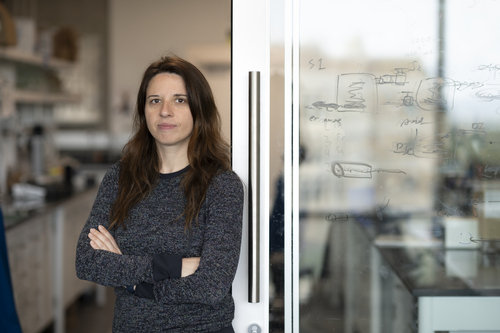
August 21, 2026 - Iryna Zenyuk, UC Irvine professor of chemical and biomolecular engineering, has won the Zhaowu Tian Prize for Energy Electrochemistry, an annual global award bestowed by the International Society of Electrochemistry (ISE) to researchers under the age of 40 for outstanding achievements in electrochemical energy science, storage and conversion.
Zenyuk is the director of the UCI National Fuel Cell Research Center and co-director of the Engineering + Sustainability Institute. She is also a UCI Chancellor’s Fellow, and professor of mechanical and aerospace engineering and materials science and engineering.
The ISE recognized her important work in the field of hydrogen electrochemical technologies, chemical manufacturing, and overall energy conversion and storage. They noted her “contributions towards understanding coupled transport and reaction kinetics in porous media with X-ray transmission and spectroscopy techniques.”
Electrochemical devices such as fuel cells and electrolyzers rely on porous catalyst layers, whose sponge-like structure packs an enormous catalyst surface area into a thin film. For the device to work, reactants such as oxygen or water must travel through this porous network to reach the catalyst sites, while products are carried away. Zenyuk's group uses X-ray techniques, including tomography and absorption spectroscopy, to watch these processes as they happen inside an operating device. The methods capture both the structure of the porous layers and the chemical state of the materials within them, revealing how transport and reaction are coupled and pointing the way to designs that make hydrogen technologies more efficient and durable.
Zenyuk’s lab focuses on electrochemical technologies that recycle energy and critical resources, including fuel cells for transportation and data centers, electrolyzers for hydrogen production, and grid-scale energy storage systems.
She develops cutting-edge experimental diagnostics, characterization tools, materials design strategies and computational models to uncover the mechanisms that limit device performance and longevity. These technologies could provide hydrogen fuel-cell solutions for heavy-duty vehicles and more. Her lab is also designing next-generation electrochemical systems that can enable pathways to decarbonize industries, such as the cement industry.
As part of her Friedrich Wilhelm Bessel Research Award from the Alexander von Humboldt Foundation in Germany, Zenyuk is currently on a research stay in Germany where she is expanding collaboration with European partners.
- Natalie Tso
