
Two UCI Researchers Make Breakthroughs During Los Alamos National Lab Fellowship
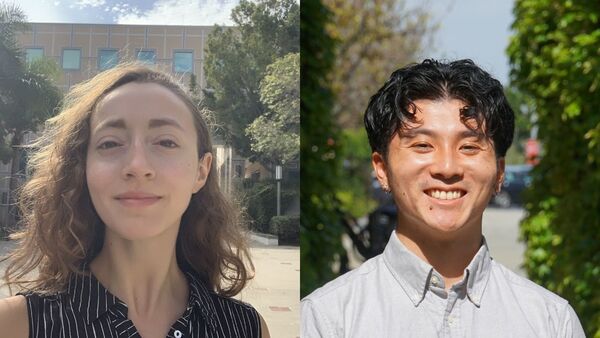
Sept. 2, 2026 - Using a kitchen microwave to synthesize battery materials and teaching a quantum computer to predict the behavior of materials are some of the key breakthroughs that two Ph.D. students at the UC Irvine Samueli School of Engineering have made during their fellowship with the Los Alamos National Lab (LANL) this past year.
The UCI-LANL-SoCalHub Research Fellowship gives selected students who are working in areas of common interest with the national lab the opportunity to be mentored by a UCI professor and a LANL scientist.
UCI Researcher’s Microwave Technique Advances Sodium-Ion Technology
Lithium-ion batteries are used widely today in EV batteries, phones, and computers, but there is not an abundance of lithium to support the current high demand. To address this, scientists are trying to replace the element with sodium, a far more abundant material found in the ocean and the Earth’s crust. Jared Ura, a Ph.D. student in materials science and engineering, is developing techniques to efficiently synthesize materials for solid-state sodium-ion batteries.
Current sodium-ion batteries use liquid electrolytes, which are organic and flammable. Ura is looking to replace liquid electrolytes with solid electrolytes, enabling safer, higher-performance batteries.
This year at UCI, he optimized a novel synthesis technique with a kitchen microwave that synthesizes the material in minutes. That’s a 99 percent reduction in the current processing time where they are synthesized in furnaces for 12 hours. “I think this technique can really enable such efficient synthesis on the industrial scale,” Ura said. “I think it can be applied not only to my solid electrolyte material but to other engineering materials as well.”
Ura said it was great to work with UCI Associate Professor Kai He. He also enjoyed working with other graduate students and mentoring six undergrads at He’s UCI lab.
At Los Alamos, Ura worked on characterizing the materials at very small scales. At the national lab’s Center for Integrated Nanotechnologies, Ura utilized cryogenic transmission electron microscopy to develop relationships between microwave processing, battery performance, and material structure at the atomic scale. “Being able to go to New Mexico and work with these top-of-the-line instruments has been a unique experience for me,” said Ura. “The expertise of my mentor Dr. John Watt has really accelerated the progress in my Ph.D. and my professional development.”
Beyond Supercomputers: Quantum Computing for Advanced Materials Simulation
Sofia Pilar Brown, UCI mechanical and aerospace engineering Ph.D. student, said the opportunities and resources — including a quantum computer simulator — at Los Alamos accelerated her research. “The LANL experience was amazing. They have a quantum computer simulator,” she said. “I love the researchers I met who are working on quantum computing and materials science. I was provided with different perspectives and ideas that really boosted my research.”
Brown is translating materials simulations, the kind that predict when a part will bend, crack, or hold, into the language of quantum computers. "Engineers can already simulate how mixed materials deform under stress, but only simplified formulations have been written as quantum circuits,” Brown said. “I now have a general elastic version running, meaning realistic mixed materials that deform under load and spring back. It gives the right answer on a classic test case, a particle embedded in a surrounding material, so we know the circuit is predicting the material's behavior correctly."
The motivation for using quantum techniques for these simulations is scale. The accuracy of the simulations depends on how finely the material's internal structure is resolved and the computational cost climbs steeply as that detail increases. Realistic microstructures can push the problem out of reach even on large supercomputers.
Brown's goal is to determine whether a quantum computer can eventually run the simulations that classical machines cannot. The payoff in materials design will be that researchers can more accurately predict how materials behave. This would enable the design of structures that are lighter and more damage tolerant, which would be especially useful in the aerospace and related industries.
She spoke highly of and enjoyed working with her mentors Julián Rimoli, UCI professor chair of the department of mechanical and aerospace engineering, and Senior Scientist Ricardo Lebensohn at Los Alamos National Laboratory.
- Natalie Tso
