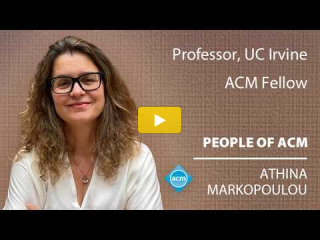
People of ACM - Athina Markopoulou
Athina Markopoulou is a Professor of Electrical Engineering and Computer Science at the University of California, Irvine (UCI). She is also the director of UCI’s California Institute for Telecommunications and Information Technology (Calit2), and of the Samueli School of Engineering’s e+Society Institute on AI (ProperAI).
She has published more than 120 papers on a broad range of computer network issues, including Internet measurement, privacy, the internet of things, and mobile data analytics.
Markopoulou served on the ACM SIGMETRICS Board and is currently the Vice-Chair of ACM SIGCOMM, and a member of the NASEM Forum on Cyber Resilience. Among her many honors, Markopoulou received an NSF CAREER Award, was named an IEEE Fellow, is an ACM Distinguished Speaker, and was recently named an ACM Fellow “for contributions to internet measurement and privacy enhancing technologies.”
You were in graduate school just when the Internet began to take off. In fact, you went to Google’s launch party when you were a student at Stanford University.Why did you decide to make computer networks your research focus?
Indeed, when I arrived at Stanford for my PhD in the late 1990s, it was the time that the commercial Internet took off. Everyone around me seemed to work on some aspect of networking, at all layers of the protocol stack, and their work had real-world impact. My advisor, Foud Tobagi, who had made earlier contributions to wireless networks and multiple-access protocols, at the time was working on multimedia over the Internet, which felt futuristic – this was way before the smartphone. Nick McKeown had just joined as an Assistant Professor, and his office was next door. So many major developments (including software-defined networking) came out of his group. I also spent some time in David Cheriton’s distributed systems group at Stanford, as well as in his Gigabit Ethernet group at Cisco, and in early days of Arista Networks. After graduation, I went on to do a postdoc with Nick Bambos and Balaji Prabhakar on network algorithms.
The enthusiasm around networking was contagious at the time, and Stanford was really good at making the interactions with the industry feel seamless. Several grad students in our cohort went on to become major innovators and players in the networking industry. An attractive feature in the field of networking for me was the fact that, despite its overall complexity, several aspects of its key aspects are amenable to elegant mathematical treatment (e.g., through graphs, matching problems, optimization), and of course its practical relevance and transformative potential for society.
One of your most cited works is the 2004 paper “Characterization of failures in an IP backbone.” In the paper, you and your co-authors sought to classify various network failures that impact Internet protocol (IP) connectivity. Using your approach, how was the field better able to understand traffic engineering problems?
That paper was done in Sprint’s Advanced Technologies Lab in Burlingame within the IP Group led by Christophe Diot, who had assembled a fantastic team. I was thrilled to have access to real logs from a major Internet service provider, being able to identify patterns, and explain the failures. Beyond being useful the operator, the work was also useful for other researchers who needed a realistic model to simulate failures and test their solutions, which is why that paper is well-cited. I want to give credit to Christophe Diot, whose vision was instrumental in establishing the Internet Measurement Community (IMC), of which I have been a member for many years.
Researchers in the IMC community combine domain expertise with sophisticated methodologies for measurement and analysis. The goal of measurement has recently moved from performance to privacy, security, and censorship issues, and the methodologies increasingly use machine learning. Another trend I see in Internet measurement research is to understand the deployment and behavior of AI agents on the web and on the Internet more generally. To give some concrete examples, my own papers that appeared in IMC the last few years are about using measurements to understand data collection and profiling practices when users interact with voice-assistants, AI chatbots, and children-directed online services. I now use network measurement as a lens to understand privacy and safety, from the perspective of the end-user, rather than to characterize network properties from the network operator’s perspective.
In 2020 you were awarded a $10 million grant from the National Science Foundation for the ProperData project, an initiative to protect personal data on mobile devices. Will you tell us a little about this effort?
ProperData was a center-scale NSF SaTC Frontiers project whose goal was to “Protect Personal Data Flow on the Internet,” now in its final year, of which I had the honor of being the director, and which included 10 Principal Investigators across 6 institutions with expertise in CS, policy, and law. We used network traffic as vantage point to observe data collection and use, including algorithmic recommendations as well as advertising and tracking practices across several platforms (Web, mobile, IoT, VR/AR, smart speakers etc.)
We performed measurements from end devices without assuming cooperation from the companies in the data ecosystem and compared the data practices revealed from our measurements to the privacy policies and laws. We also developed privacy-enhancing technologies that can be deployed on the user’s device, or close to the edge to protect their personal data.
The project was deeply interdisciplinary, bridging the gap between privacy technology and laws (such as GDPR and CCPA) by developing assessment methodologies and by informing users, developers, policy makers, and enforcement agencies (e.g., the Federal Trade Commission ( FTC)), about what data are collected and how they are used. ProperData has been one of the most rewarding projects of my career, and several of its threads and collaborations continue forward on privacy and safety of children online, privacy aspects of AI agents on the web, and our signature PR2 (policy-relevant privacy research) workshop that has become a regular attraction at the Privacy Enhancing Technologies Symposium (PETS). I am proud of what we have accomplished as a team in terms of research results and policy outreach, as well as in terms of training and placing the next generation privacy researchers and of the community we have created.
A stated goal of Calit2 is to “harness the ubiquity and scale of the Internet and wireless technologies to accelerate growth in many different scientific fields and industries.” As its new Director, what are your goals for Calit2?
I started as the new director of CALIT2, UCI Division last year. CALIT2 is one of the four California Institutes for Science and Innovation (or Cal ISIs) that Governor Gray Davis created 25 years ago to enhance the mission of the University of California, accelerate the translation of research, train the workforce, and benefit all Californians. CALIT2’s initial focus was on information and telecommunications technologies. It has always been involved in pioneering network infrastructure projects (such as CENIC across southern California, in partnership with UCSD’s Calit2/QI institute) and different applications including agriculture, health, aerial imaging, and environmental sensing, all with the goal of benefiting economy and society for California. While I am new to this role, one of our goals is to leverage and build upon this expertise and reconsider CALIT2’s focus in today’s AI era.
Having worked in a big industry-based laboratory, a startup, and academia, what advice would you give a newly minted graduate student about finding the best setting for them?
I will quote one of my mentors when I asked that question around graduation time, and they said something along the lines that, “life and career make sense when you look at them backward but it is difficult to plan forward.” They were conveying the idea that, ”you shouldn’t go to academia or industry because you think it will look good on your CV or because it may pay better in the short run. Go to the best place for the work you are interested in doing. Follow your true interests and let those guide your career trajectory.”
This being said, the environments you mentioned have different characteristics, and much has also changed over the last 20-30 years. There are no Bell Labs-type of industry labs anymore. Academia is under a lot of stress, and new PhD graduates do not always have easy paths into the workforce. The gap in resources and access to computing between industry and academia is almost prohibitive, at least for those working on AI. However, the innovation ecosystem is still alive and well, and it is an incredibly exciting time to be a researcher in computer science today, especially working on AI and AI-adjacent fields. I would encourage new graduates to pursue the sense of excitement and accomplishment that comes from creating such transformative technologies, but also to consider the impact that their work has on society and design with that responsibility in mind.
- This story was originally posted by the Association for Computing Machinery.