
Master of Engineering Students Honored for Innovative Capstone Projects
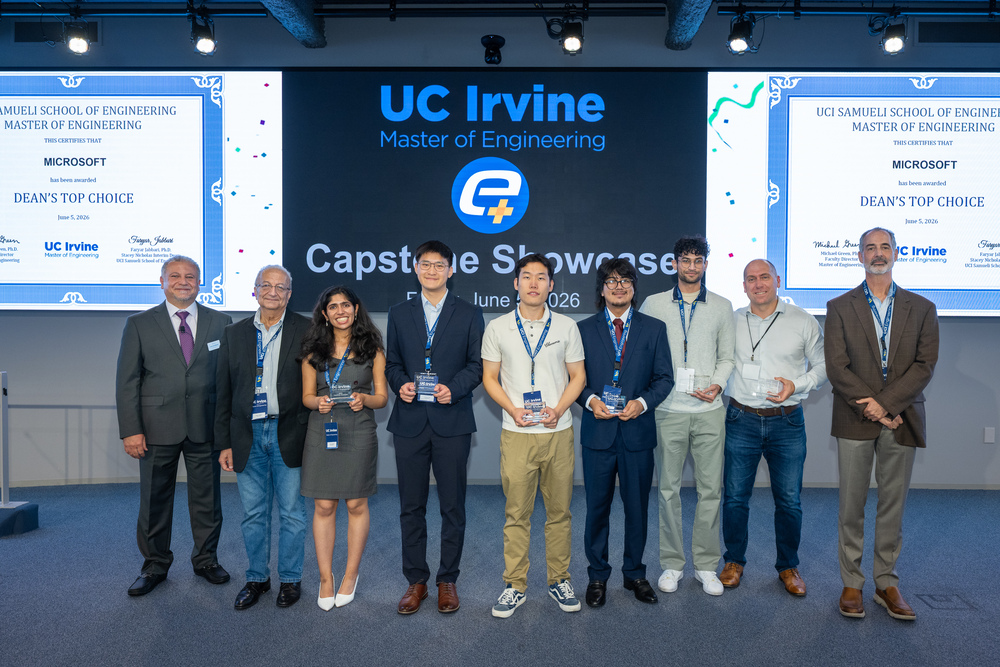
June 10, 2026 - Generative AI, sleep health and aircraft material testing were among the projects tackled in this year’s professional Master of Engineering program at the UC Irvine Samueli School of Engineering. The graduate students partnered with 17 companies, municipalities and institutes to create solutions to real world problems. The nine-month professional engineering program includes the opportunity to take on a capstone project proposed by their sponsors.
“The capstone project is the cornerstone of the Professional Master of Engineering program. It provides students with a unique experience that extends beyond advanced graduate-level coursework,” said the program’s faculty adviser Farzad Ahmadkhanlou. “Through the capstone projects, students receive direct mentorship from experienced industry professionals while working on cutting-edge technologies.”
The following are the team winners for the 2025-2026 academic year:
Dean’s Top Choice: Microsoft AURA capstone project
Modern computer chips are constantly becoming smaller and more powerful, but redesigning the sensitive analog circuits inside them is incredibly time consuming. Thus, semiconductor companies aim to migrate existing analog intellectual property (IP) to newer process nodes rather than redesign the circuits. In collaboration with Microsoft, students developed AURA, a multi-agent generative AI workflow that automates the process of taking an existing analog circuit blueprint and adapting it to work in a newer, smaller chip manufacturing process. It migrates analog Spectre netlists, which describe the circuit’s connectivity and components, from a 90 nanometer to a 45 nanometer process node.
“We were working at the intersection of generative AI and analog EDA, which is a space that hasn't been deeply explored, and helping the team work together to overcome the complexity of this challenge was very rewarding,” said team lead Ananya Batra. Their initial circuits testing results show that AURA meets designer-specified performance constraints, demonstrating that LLM-based automation can meaningfully accelerate analog retargeting to the newer process nodes.
“I believe agentic AI workflows are the next wave of AI development, and I'm grateful this capstone gave us the opportunity to contribute to that space in a meaningful way and learn a lot,” said Batra. “I'm incredibly happy we won and am very grateful for the guidance of our faculty adviser, Farzad Ahmadkhanlou, and our Microsoft liaisons Joe Tostenrude, Yousef Iskander and Richard Paw.”
The team has submitted a conference paper and will demonstrate their novel research findings at a booth at The Chips to Systems Conference which will be held July 26–July 29 at the Long Beach Convention Center.
Students of the program often make notable contributions to industry. “We often describe the Capstone Project as a mini-internship that offers many of the benefits and experiences of a full internship,” Ahmadkhanlou said. “With this invaluable experience, the award-winning students and teams distinguish themselves through a combination of innovation, patents, and publications.”
Dean’s Choice Runner Up: Panasonic Avionics Capstone Project
The Panasonic Avionics team aimed to discover how materials inside an airplane cabin, such as seat cushions and wall panels, behave when they catch fire. They developed a way to pre-stress test these materials under controlled burn conditions to measure how fast they heat up, how much heat they release, and how dangerous they could be in a real fire scenario. The team developed a simulation tool using data and material properties from test samples of materials to better understand their combustion trends and predict heat release behavior. They also developed a transient thermal and heat release analysis framework for early design testing of these materials. The team’s work contributed to four patentable ideas.
“UCI has a very good program. Working with industry is so valuable,” UCI advanced manufacturing graduate student Norman Hsu said. “You have real time meetings with managers, and they are kind to students and willing to coach you.” Hsu said he enjoyed working with Panasonic as it helped him better understand what the company is looking for in their employees.
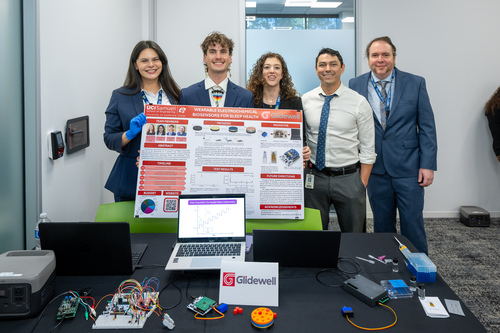
Executive Committee Award – Glidewell Capstone Project
The Glidewell capstone project is a wearable salivary electrochemical biosensor for sleep health. The project focused on both electrochemical and electronics research to develop a sleep health monitoring device that tracks cortisol levels as the user sleeps. The team designed a system using off the-shelf screen-printed electrodes (SPEs) and developed a fully integrated printed circuit board (PCB) to demonstrate the feasibility of continuous cortisol concentration tracking throughout a sleep cycle in a noninvasive manner.
Biomedical engineering graduate student and team lead Dana Kadifa said she appreciated the freedom and independence the project gave them as well as the guidance of the company liaisons. “As a scientist one of my favorite things is to just be able to do the work, research and study it,” she said. Kadifa found the partnership with Glidewell to be very beneficial to their research and development of ideas. “It was an awesome experience. Our liaisons are very welcoming, kind and active,” said Kadifa. “If we ever needed help or to bounce ideas, they were always there.”
Executive Committee Runner Up – Advantest Capstone Project
The Advantest capstone project solves a common data tracking problem in the semiconductor industry. The team created a platform for dashboards and tools for users to monitor semiconductor testing machines in real time for actionable analysis. As a semiconductor testing machine generates data, the backend processes and converts that data to a frontend dashboard where results are monitored live. Alerts are sent out when errors or unscheduled downtime occurs, which enable users to respond to issues faster.
For Rajiv Agrawal, the Advantest liaison, this was his first time working with graduate students on a capstone project. Agrawal said it was a great experience, and he was impressed with the students' drive throughout the project. “The rate of progress from the time they started was high and they were able to grasp things very fast,” he said.
Justin Leong, an electrical engineering graduate student, served as the team lead for this project. He appreciated the dynamic communications between the students and their liaison during their weekly meetings. “Agrawal was very easy to talk to. We would always have long meetings to get an idea of what exactly he wants and what we were supposed to do.” Regardless of the many learning curves his team encountered, Leong said they stayed highly motivated throughout the project.
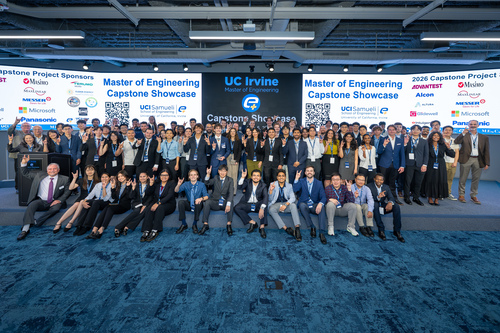
This year, the companies Alcon, Panasonic, and Terumo Neuro received the Master of Engineering Silver Sponsor Awards as they each sponsored three capstone projects.
To learn more about the UC Irvine Professional Master of Engineering program, visit the website.
- Natalie Tso and Caroline Lu
