
Researchers Uncover Hidden Rules Governing Growth of River Deltas
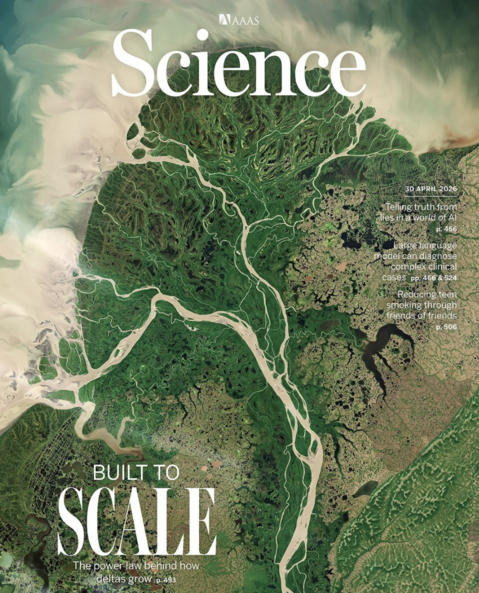
May 28, 2026 - River deltas are among the most vital, densely populated, and severely threatened landscapes on Earth. An international team of scientists, including many affiliated with UC Irvine, has published a breakthrough study in the journal Science decoding the mathematical rules underlying the structure of delta channel networks and their ability to build land. The study made the cover of the April 30, 2026 edition of Science.
"Deltas are extremely dynamic environments. They are home to millions of people and are essential for global biodiversity and food security, but they are currently facing unprecedented threats due to sea-level rise and human activities," explains Alejandro Tejedor, research associate in the Department of Civil and Environmental Engineering at UC Irvine and co-author of the study.
For decades, geomorphologists have relied on "Hack’s Law" to describe the organization of mountain drainage basins, where multiple streams converge into a single river. However, this rule was largely considered inapplicable to deltas, where the flow instead branches out into multiple distributary channels to deliver sediment to the ocean.
The new study, "Apparent Hack’s Law in River Deltas," shifts this paradigm. Through an exhaustive global data analysis, the team demonstrated that deltas follow scaling relationships that are remarkably identical to those of mountain basins. The researchers identified a direct mathematical connection between the length of a channel and its "nourishment area" — the landmass that each specific channel branch is capable of sustaining through sediment deposition.
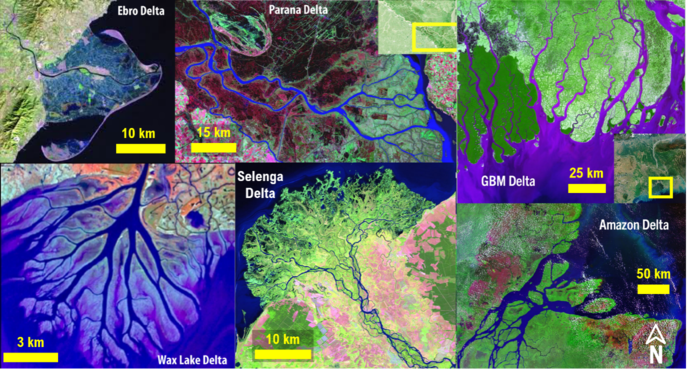
The study also goes a step further by revealing a surprising duality: while all deltas appear to follow this unified rule globally, they exhibit two distinct modes of growth at the local level (uniform and composite networks), proving that global simplicity and local variability can coexist in nature.
"This discovery gives us a fundamental tool,” said Tejedor. “By understanding the architecture of the channel network, we can better predict how sediment is distributed and which areas of a delta are most likely to survive or be submerged." The findings reveal that the spatial organization of these channel networks is not random; it follows a geometric efficiency that allows the delta to expand predictably.
"By applying network analysis to satellite imagery of deltas worldwide, we were able to uncover an underlying order in these seemingly chaotic landscapes," notes Lawrence Vulis, co-author and a UC Irvine alumnus who was a member of Distinguished Professor Efi Foufoula-Georgiou's group in UCI's Department of Civil and Environmental Engineering. "This geometric rule acts as a practical baseline for scientists, engineers, and coastal managers to assess how these critical regions might respond to future environmental changes and human interventions," he said.
The research was led by the University of Texas Rio Grande Valley, with key contributions from experts at UC Irvine, the University of Zaragoza (Spain), the University of Illinois, and the University of Texas at Austin. This international collaboration highlights the power of multidisciplinary research to address pressing global environmental challenges. By bridging the gap between physics, geomorphology, and environmental engineering, the study opens new avenues to deeply understand the mechanics of coastal ecosystems and design better restoration strategies for the world's most vulnerable shorelines.
- Natalie Tso
