
Grosberg Creates Way to Research Sex-based Variations in Cardiac Function

Feb. 13, 2026 - Anna Grosberg, UCI professor of biomedical engineering, and Ph.D. student Mary Tran have made the first characterization of the difference between male and female neonatal rat ventricular myocytes (NRVMs) in vitro tissues. Their work was just published in the Proceedings of the National Academy of Sciences (PNAS) and offers a way to study sex-based variations in cardiac tissues and function.
Male hearts are on average larger, heavier and have thicker ventricular walls compared to female hearts. These differences have important implications for diagnosis, treatment and risk assessment for cardiovascular diseases. It’s not, however, fully clear what leads to these differences, and it’s even less clear how cardiac structure differs between male and female hearts at the tissue scale.
The ability to engineer and assess sex-specific confluent cardiac layer in a controlled setting offers a novel approach for exploring the biological basis of sex variations in cardiac structure and function. In their study, Tran and Grosberg reported sex-specific bioengineered rat cardiac cell sheets showing structural and functional distinctions between male and female, that were qualitatively different from any differences seen at a single cell scale.
Their research shows that their in vitro heart-on-a-chip platform engineered with primary NRVMs can serve as a model that shows how characteristics are driven by sex chromosomes in identical experimental conditions. The self-assembly of isolated cardiomyocytes, the muscle cells that drive the pumping of blood, resulted in differences in the structure of the contractile apparatus located within those cells. More importantly, the assembly of cardiac cells into confluent monolayers drove the differences in both structure and the corresponding function between the sexes. Providing this reproducible, controllable platform enables exploration into how intrinsic cellular sex differences translate into the structural and functional variations observed clinically. This data can inform more targeted drug treatment strategies.
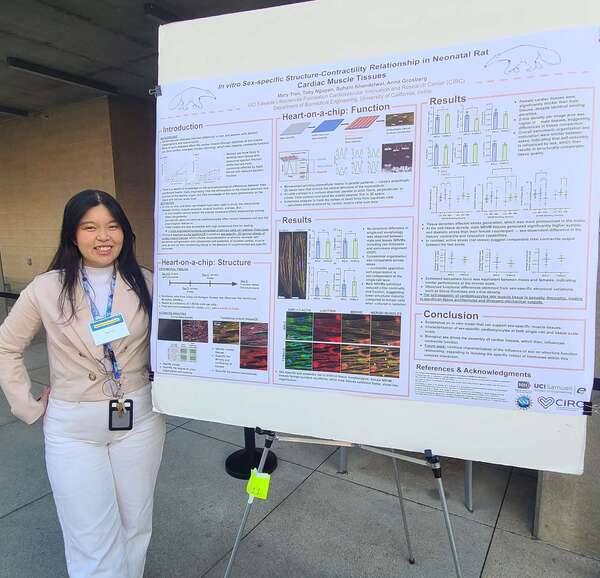
Grosberg’s Cardiovascular Modeling Laboratory focuses on using computational and experimental methods to study the structure, dynamics and function of the heart at multiple length-scales. Grosberg’s ultimate goal is to leverage this controlled in vitro platform to identify the mechanisms by which sex, genetic variations, inflammation, hypoxia and other factors influence cardiac remodeling and function, leading to progression of heart disease and heart failure.
UCI biomedical engineering undergraduate students Toby Viet Nguyen and Suhani Khandelwal were co-authors in this paper.
Grosberg is a core member of UCI Edwards Lifesciences Foundation Cardiovascular Innovation and Research Center (CIRC) and has a joint appointment with the Department of Chemical & Biomolecular Engineering. She is also part of the Center for Complex Biological Systems, Stem Cell Research Center, and the NSF-Simons Center for Multiscale Cell Fate Research.
- Natalie Tso
