
AI Experts Showcase Innovative Research at UCI Engineering+ Society AI Symposium
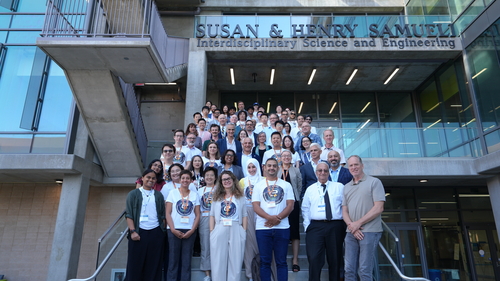
Oct. 5, 2026 - Creating a digital twin of a beloved father, personalizing physical rehabilitation devices, and monitoring the impact and safety of artificial intelligence were among the topics discussed at the inaugural UC Irvine Engineering+ Society Institute on AI (Proper AI) Symposium on Sept. 29, 2026.
The institute brings together professors and innovators in engineering, social sciences, art, business, and public policy that meet regularly and work on collaborative projects. The symposium featured these experts’ insights and innovations at the half-day event held at UCI at the end of its first year since the institute’s launch.
“This is a prime example of activation energy — bringing together people in other areas of inquiry so we can get a better hold of challenges and come up with better solutions,” said UCI Samueli School of Engineering Interim Dean Faryar Jabbari as he opened the symposium.
Institute embraces interdisciplinary approach to AI safety, ethics
Engineering + Society Institute Director Athina Markopoulou said that progress in AI has surpassed projected timelines but safety protocols have not yet caught up. Markopoulou, who is a professor of electrical engineering and computer science at UCI and the director of CalIT2, has been widely recognized for her work on online privacy and safety. She gave an overview of concerns over AI including its impact on jobs, critical thinking and the environment as well as the threat of deepfakes, data privacy breaches, cybersecurity hacks and super intelligence.
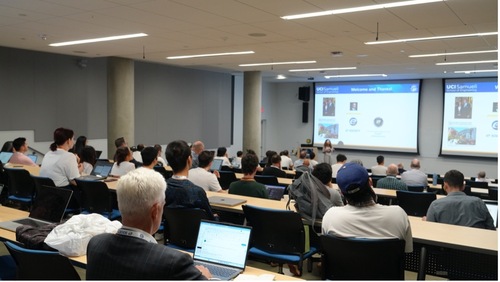
The mission of the institute is to engineer AI technologies and applications to align AI with human values for societal good. It takes a socio-technical approach, bringing together diverse expertise in the technologies of AI, along with policy and law, business and innovation, social sciences and the arts. Some of the highlighted projects included developing components and software to monitor AI and improve user privacy and safety, overseeing government chatbots, and auditing chatbot interactions with children.
Bill Maurer, dean of the UCI School of Social Sciences, talked about the societal risks of artificial intelligence, as AI is an interdependent system which presents risks to banks and the financial ecosystem. UCI social science professors are researching core problems for multi-agent AI, the threat of misinformation, and the study of human-AI decision-making. Anna Leshinskya, UCI assistant professor of cognitive sciences, explained how her research is uncovering the difference in moral reasoning between humans and artificial intelligence and how those discoveries can help align AI with human values.
Jesse Colin Jackson, director of the Beall Center for Art + Technology, described the role of the Arts in the institute. The symposium also featured exhibits on the impact of AI, in collaboration with the engineers in the institute. These were scaled down version of the xMPL exhibit, which took place in June including BLINDSPOT -- a software that can enable users to opt out of facial recognition through swiping one’s hand over one’s face. Another exhibit demonstrated true life conversations between chatbots and humans, reported as problematic in the AI Incident Reports Database, as they encouraged destructive behavior such as self-harm.
Developing innovative AI applications
At the symposium, many leading researchers presented their groundbreaking work in the applications of artificial intelligence. UCI Beall Applied Innovation AI Strategy & Innovation Executive Stuart Mathews discussed how he created a digital twin of his beloved 100-year-old father by inputting a detailed account of his father’s life and writings so that his family could interact with the twin and benefit from his father’s wisdom. Matthews shared how his father believes the twin acts in tune with his values and demonstrated this by asking him a question. Mathews had a conversation in real-time with the AI twin of his father, told him that he was feeling very stressed, and it responded by recounting how he dealt with uncertainty on an aircraft carrier in WWII by focusing on the task at hand and relying on his faith.
Sasha Voloshina, UCI assistant professor of mechanical and aerospace engineering, shared how she is using AI to provide personalized physical rehabilitation support. Her device identifies a patient’s individual performance signatures such as muscle activity and movement patterns and adapts the rehab devices to those elements to strengthen and accelerate the effectiveness of the rehab.
UC and California leadership in governing AI
Camille Crittenden, director of the Tech Policy Initiative at CITRIS, UC Berkeley, and collaborator of the institute, shared how the University of California has been leading the way among American universities in espousing responsible AI principles such as monitoring information integrity and worker protections.
California also leads the United States with its strict laws that require tech companies to provide safety reports, label AI-generated content, and allow consumers to reach human customer service agents. Callifornia has also passed laws safeguarding minors from extended conversations with chatbots and is passing laws to protect workers from the impact of AI. Recent state legislation also requires data centers to report on their water usage and environmental impact.
The UCI institute also promotes collaboration between the UC campuses. Last week, it hosted the first of a series of workshops with AI researchers at UCLA on trustworthy AI. To educate youth about digital safety and privacy, it also hosts summer programs on AI for high school students.
As the world faces unprecedented challenges and opportunities due to the advancement of artificial intelligence, UC Irvine’s Engineering + Society Institute for AI (Proper AI) is gathering leading minds to create solutions and innovations to help us navigate the age of AI more wisely.
“The goal of AI safety as well as the socio-technical approach of our institute are more relevant and important than ever”, said Markopoulou. “We are grateful to the Samueli Foundation and to the UCI Samueli School of Engineering for supporting our “e+Society” institute on AI (ProperAI) and empowering us to work on this grand challenge of our time.”
- Natalie
